

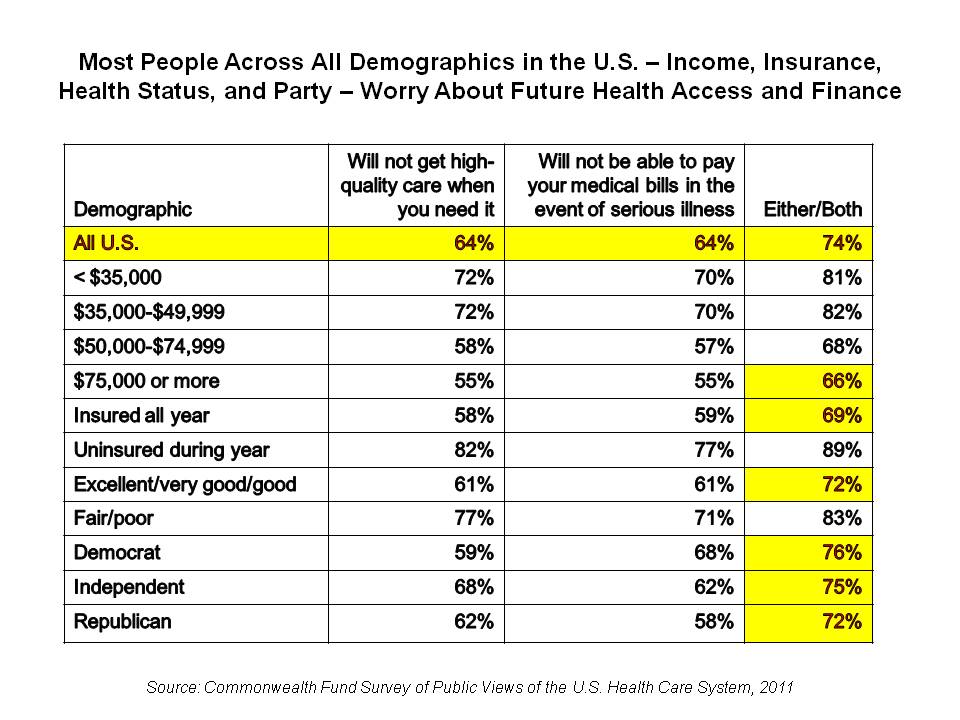
 It is no surprise that sicker, poorer people in the U.S. have concerns about how they’ll access and pay for health care in the future.
What stands out in the latest Commonwealth Fund Survey of Public Views of the U.S. Health System, published in an April 11, 2011, Issue Brief, is that most U.S. health citizens in the healthiest, wealthiest demographic groups worry about accessing and paying for health care in the future.
The chart highlights these findings: overall, 7 in 10 people worry about not getting high-quality care when they will need it, or that they won’t be able to pay medical bills in the event of serious illness. Underneath that aggregate number, it’s no surprise that 81% of people with less than $35,000 annual income have these concerns, or that those in fair/poor health do.
The other illuminating data point is that whether Democrat, Independent, or Republican, over 7 in 10 people worry about future personal health access and financing for medical bills if they get very sick.
Thus, The Commonwealth Fund titles this Issue Brief, “A Call for Change.” Nearly 1 in 2 people say there are “fundamental changes” needed in the U.S. health system, with 1 in 4 asserting the system needs a complete re-build. Even most of the wealthiest Americans say fundamental changes are needed to remake the U.S. health system.
Access problems include challenges getting care off-hours (cited by 58% of all U.S. adults); getting advice from your doctor by phone during regular office hours (noted by 39%); and, getting an appointment with a doctor the same or next day when sick, without going to the emergency room (29%).
One of the solutions included in this survey concerned peoples’ perceptions of health information technology (HIT). 88% of health citizens said that doctors’ use of computerized medical records would be important to improve patient care. And, 92% said that doctors can share information electronically with other doctors to improve care. Furthermore, At least one-half of U.S. health citizens would like Internet-based health services, including:
- Communicating with their doctors via email, 57%
- Scheduling appointments via email or Internet, 56%
- Ordering/refilling a prescription using the Internet, 55%
- Accessing their medical records via Internet, 50%.
Health Populi’s Hot Points: Health care quality doesn’t pass the sniff test for U.S. health citizens: most recognize a broken system, as evidenced by this poll’s numbers. While Donald Berwick and other health leaders have had the data to prove this, Mainstream America gets the point now, as shown by The Commonwealth Fund’s survey. Most people say that it would be “very important” to have one place or doctor responsible for their primary care, a place to go after hours other than the ER for care, and information transparency about quality and costs of their provider choices.
Thus, another no-surprise: most U.S. health citizens support the concept of medical homes throughout the U.S. and across political parties.
Ironically, the concept of a primary care backbone and medical homes are the cornerstone of the Affordable Care Act. Most Americans still don’t seem to know this basic fact about health reform.
 Jane will be working with EU- and UK-based clients in September and October 2026, collaborating with stakeholders in digital health, public/community health, retail health, and growing opportunities for health-at-home. Stay tuned to her updates here on Health Populi on-the-ground as she lives the digital nomadic work-life in Italy, Belgium, the Netherlands, and in London.
 I was grateful to be Jasmine's first conversation-guest on her new podcast,
  Jane joined host Dr. Geeta "Dr. G" Nayyar and colleagues to brainstorm the value of vaccines for public and individual health in this challenging environment for health literacy, health politics, and health citizen grievance.